I placed the text of my previous post in ChatGPT, asked it to expand into a small book. Then generate twenty titles, sort and pick best. Boom!
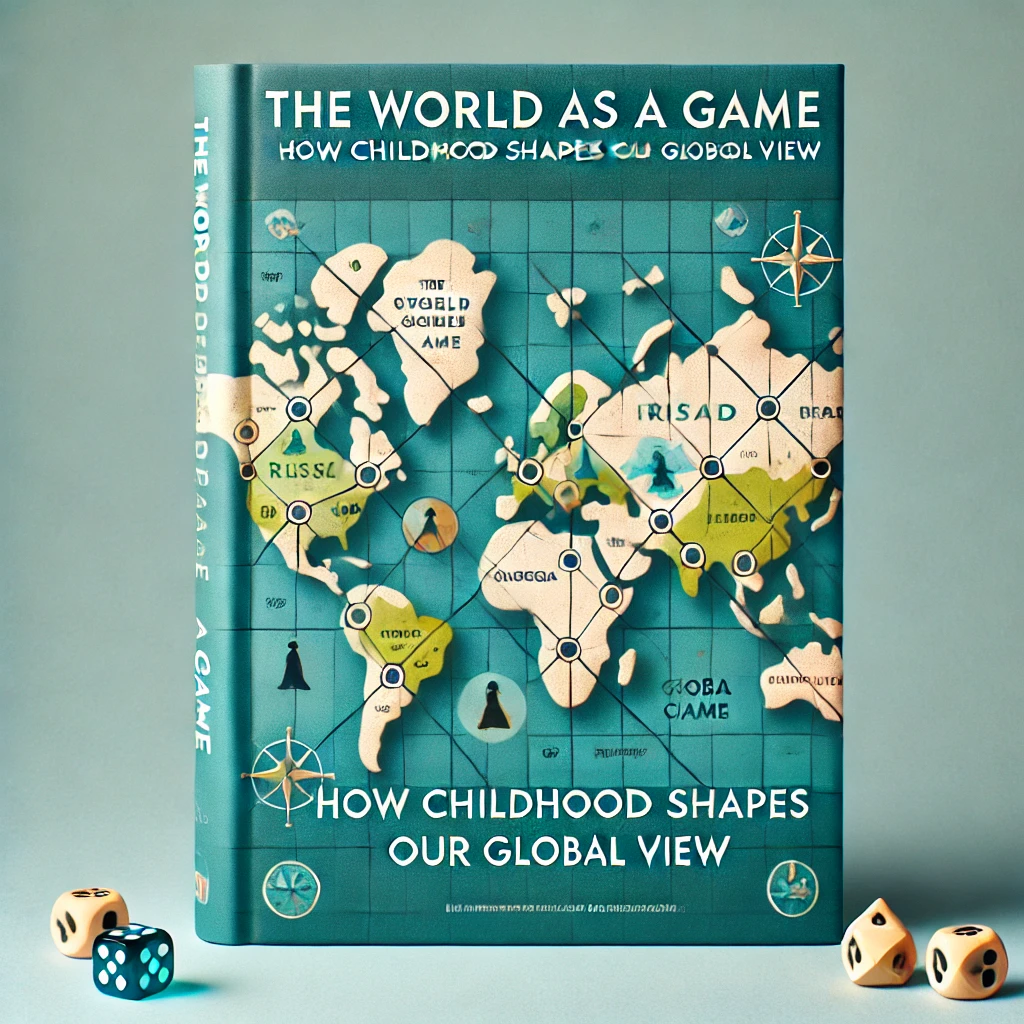
The World as a Game: How Childhood Shapes Our Global View
Chapter 1: A Simplified World – Childhood Games as First Maps
In this chapter, we dive into the idea that board games like Risk are often a child’s first encounter with a mapped-out version of the world. We’ll explore how these games create an illusion of understanding geography and politics through colored territories and simplified continents, imprinting early ideas about the size and scale of the world.
This chapter will also discuss how simplified worldviews are not inherently negative but rather a natural starting point for developing a deeper understanding. We’ll examine how these games can serve as gateways to curiosity, leading some players to later investigate the real-world locations they once saw as mere spaces to conquer. We’ll touch on research into childhood development, examining how simplified models like game boards contribute to early learning and influence how we interpret the world as adults.
Chapter 2: The Power of Control – Mastery and the Illusion of Influence
This chapter unpacks the thrill of control that comes with childhood games. In games, players are given a small “world” where they’re in charge, choosing when to attack, expand, or withdraw. But real life rarely offers such straightforward control. We’ll explore how this early sense of mastery, while empowering, can shape an adult expectation that events, people, and outcomes can be manipulated or “won” with the right moves.
Here, we’ll delve into psychological concepts such as the “illusion of control” and discuss studies showing how people are often inclined to overestimate their influence over events. By analyzing this concept, we’ll look at how games can create a skewed understanding of power and control, which can either motivate us to be more proactive or leave us disappointed when the world defies our efforts.
Chapter 3: Winning and Losing – The Early Lessons of Competition
This chapter explores how childhood games introduce us to competition, creating a binary world of winners and losers. We’ll examine how the simplicity of winning and losing affects our beliefs about success and failure, sometimes fostering an “us vs. them” mentality.
Through the lens of games, we learn that victory brings satisfaction, and defeat invites reflection—or frustration. But how does this shape our approach to complex real-life scenarios, where "winning" often has nuanced consequences? This chapter will discuss how binary thinking in games might influence our adult perspectives on economic or political competition, as well as interpersonal relationships, and how we might learn to embrace more nuanced definitions of success.
Chapter 4: The Allure of Territory – Borders, Boundaries, and Ownership
The concept of territory is foundational in many games, from claiming properties in Monopoly to continents in Risk. This chapter examines how the game-driven notion of “territory” affects our adult understanding of space, ownership, and nationalism.
We’ll explore how childhood games can unintentionally foster territorial thinking—reinforcing the idea of property and ownership as central to success. Through historical examples and psychological studies, we’ll examine how early notions of “mine vs. yours” and border-building in games can later influence our views on national borders, cultural divides, and even the modern concept of personal space. Additionally, we’ll look at the way games can both simplify and distort our sense of what it means to possess land or property in the real world.
Chapter 5: Conflict and Peace – What Games Teach Us About War and Diplomacy
Games make conflict feel manageable, even fun. In Risk, wars can be started and finished with the roll of dice, and players don’t witness the devastation caused by war. This chapter explores how games shape our ideas about conflict and diplomacy, making them seem simpler or even attractive.
Here, we’ll dive into the limitations of a game-based perspective on conflict, discussing how the allure of winning in games contrasts with the tragedies of real-world wars. We’ll examine the psychological distance that games create and discuss how early exposure to simplified conflict can shape our views on military intervention, diplomacy, and the ethics of war. This chapter also includes an exploration of historical board games and how they reflect (and sometimes reinforce) certain cultural attitudes toward war.
Chapter 6: Alliances and Betrayals – Childhood Lessons in Trust
Many board games require players to form alliances and occasionally betray one another for strategic advantage. This chapter investigates how these early lessons influence our views on trust, loyalty, and negotiation.
We’ll explore how the experience of forming alliances in games shapes our understanding of relationships, competition, and collaboration in the real world. From children’s friendships to adult alliances—personal, professional, and political—this chapter looks at how games provide a controlled space to experience trust and betrayal, teaching valuable lessons that can both help and hinder our ability to navigate complex relationships.
Chapter 7: The Risk of Over-Simplification – What Games Leave Out
This chapter confronts the reality that games, by design, leave out many complexities. They provide a condensed version of real-world dynamics, one that prioritizes action over nuance. This chapter examines what’s missing—culture, context, history, and individual voices—and how these absences influence our worldview.
Using case studies of historical conflicts, this chapter explores the risks of oversimplification in our understanding of international relations and human societies. By discussing what games omit, we’ll delve into the ways we can move beyond simplistic views and develop a richer appreciation for the intricacies of real-world issues.
Chapter 8: Control Versus Chaos – Learning to Embrace Unpredictability
In games, outcomes are mostly determined by rules, probabilities, and strategies. This chapter discusses the predictable structure of games versus the chaotic nature of real life, where variables often defy control.
We’ll explore how our desire for order and predictability—fostered by game mechanics—can leave us unprepared for the uncertainty of adulthood. Through personal stories and psychological studies on resilience, we’ll discuss the value of embracing unpredictability and learning to adapt rather than control. We’ll also discuss how we can integrate a more flexible approach into our daily lives, moving beyond the binary of order and chaos.
Chapter 9: Beyond the Board – Imagination and the Expansion of Worldview
In this chapter, we celebrate the role of imagination, an often-overlooked aspect of childhood play. Playing board games, children often make up stories, creating complex backgrounds for territories, armies, or even tokens.
We’ll explore how imagination expands our worldview, allowing us to see beyond the surface of the board and create deeper, more complex narratives. By fostering creativity and empathy, these moments of imagination can help us develop a more holistic understanding of the world. This chapter also examines how imaginative play can bridge the gap between the simplifications of games and the complexities of reality.
Chapter 10: Nostalgia and Perspective – Revisiting the Games of Our Youth
As adults, we often revisit the games of our youth with a sense of nostalgia, but also with new insights. This chapter explores how our perspective shifts over time, allowing us to see childhood games in a new light.
Through interviews and personal stories, we’ll look at how revisiting these games helps us understand our past selves and the beliefs we developed early on. We’ll also explore how these games can serve as markers of personal growth, helping us reflect on how our worldview has evolved and what we still carry from those early days at the game board.
Chapter 11: The Digital Frontier – New Generations, New Games
The digital age has transformed childhood play, with video games and virtual environments introducing new ways to experience the world. This chapter explores how the digital transformation of games affects how new generations view the world and interact with global issues.
We’ll look at the pros and cons of digital gaming, from the increased realism that fosters empathy to the potential detachment that can arise in virtual worlds. By comparing traditional board games to immersive video games, this chapter considers how modern games shape perspectives on conflict, cooperation, and global citizenship, and the possible long-term effects on worldview.
Chapter 12: Real-World Application – Learning to Think Beyond the Game
In this concluding chapter, we focus on bridging the gap between the simplicity of games and the complexity of real life. While games provide valuable lessons in strategy and decision-making, they can also foster oversimplified thinking.
Through practical exercises and examples, this chapter offers readers ways to integrate game-based insights into their real-world interactions while remaining aware of the limitations of game logic. We’ll explore how to balance strategic thinking with empathy, nuanced understanding, and a respect for the unpredictable nature of life. By the end of this chapter, readers will be encouraged to view the world as a dynamic place that goes beyond the board, embracing its full complexity while making use of the tools and lessons they’ve gathered along the way.
Conclusion: From Board Games to Real Life – Embracing the Full Picture
In our journey from childhood games to adult realities, we carry both the lessons and limitations of our early experiences. Games provide us with simplified models that help us understand concepts like competition, strategy, and conflict, but as we grow, we must learn to see beyond those early frameworks. This conclusion reflects on the journey we’ve taken through the book, encouraging readers to appreciate the balance between simplicity and complexity, control and unpredictability, and to respect the real-world intricacies that make life richer and more meaningful than any game could ever capture.