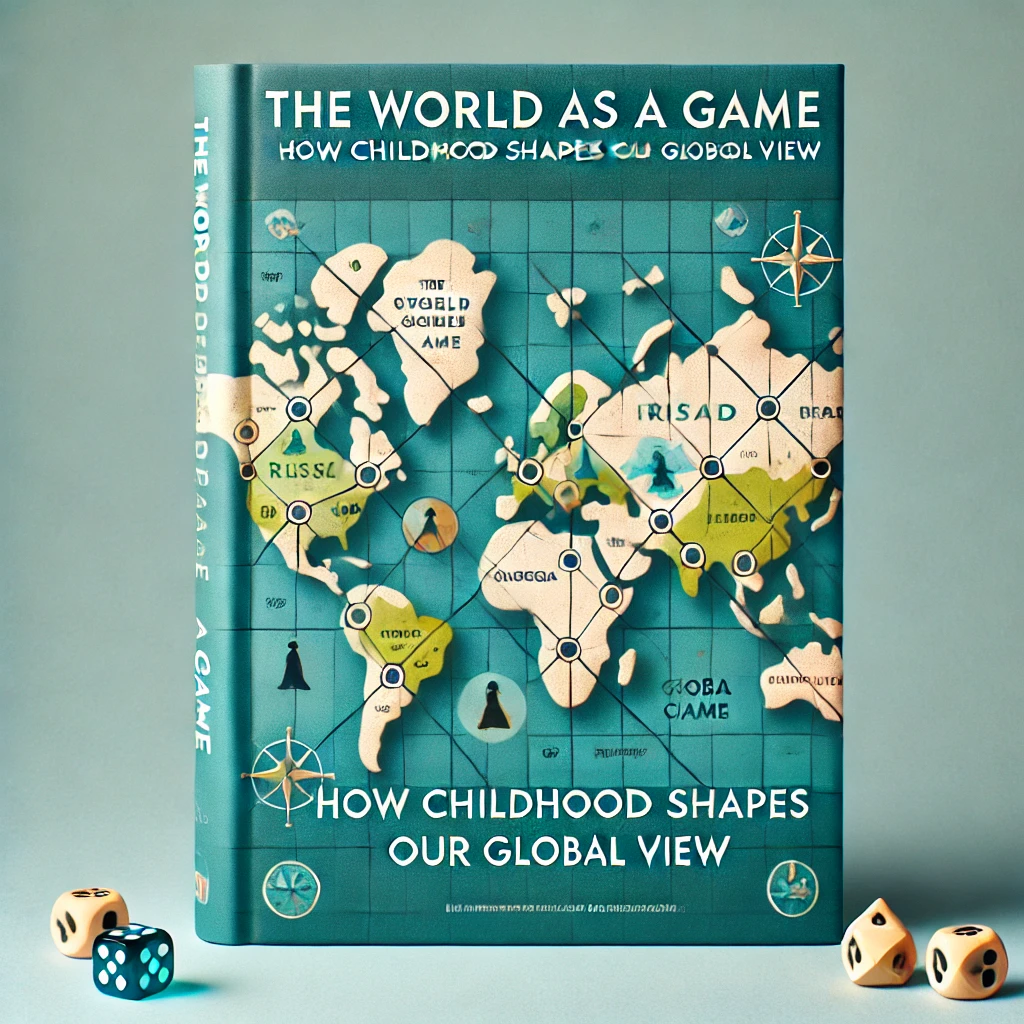
The World as a Game: How Childhood Shapes Our Global View
Table of Contents
- A Simplified World – Childhood Games as First Maps
- The Power of Control – Mastery and the Illusion of Influence
- Winning and Losing – The Early Lessons of Competition
- The Allure of Territory – Borders, Boundaries, and Ownership
- Conflict and Peace – What Games Teach Us About War and Diplomacy
- Alliances and Betrayals – Childhood Lessons in Trust
- The Risk of Over-Simplification – What Games Leave Out
- Control Versus Chaos – Learning to Embrace Unpredictability
- Beyond the Board – Imagination and the Expansion of Worldview
- Nostalgia and Perspective – Revisiting the Games of Our Youth
- The Digital Frontier – New Generations, New Games
- Real-World Application – Learning to Think Beyond the Game
- Conclusion: From Board Games to Real Life – Embracing the Full Picture
Chapter 1: A Simplified World – Childhood Games as First Maps
For many children, board games like Risk or Monopoly serve as a gateway to understanding the larger world. In Risk, for example, players view the world as a segmented map where territories are simplified into colors and borders, representing a “gameboard geography.” This segmentation is a first introduction to ideas of territory, ownership, and political boundaries. Through games, children develop a basic sense of scale, geography, and control. This chapter examines how simplified game maps, with their colorful, neatly outlined continents, introduce children to the concept of a structured world, where territories and nations seem understandable and conquerable.
These early encounters with geography provide a low-stakes way for children to explore the world without the overwhelming complexity of real-world geopolitics. However, as they mature, some may recognize that these games present a limited view, often devoid of cultural, historical, or social context. Yet, they serve as catalysts for curiosity, leading some players to later explore the real-world places they once regarded as game spaces. We delve into how game-based worldviews act as scaffolding for future knowledge, helping children build a framework to organize more detailed and nuanced information as they grow. Additionally, research into childhood development shows that simplified models, like game maps, aid in memory and learning, establishing cognitive patterns that influence how we interpret the world in adulthood.
Chapter 2: The Power of Control – Mastery and the Illusion of Influence
Games often allow players to exercise control in ways that real life does not, instilling a sense of mastery. In childhood games, players experience what it’s like to call the shots: when to attack, when to defend, and when to negotiate alliances. Games like Chess or Settlers of Catan reward strategic thinking, teaching children that they have the power to shape outcomes within the “rules” of a world. This chapter explores the powerful psychological effect of this early control, which can foster confidence but may also create an unrealistic expectation of control over life's unpredictable variables.
Studies in psychology reveal that games reinforce the “illusion of control,” a cognitive bias where people believe they can influence outcomes more than they realistically can. While empowering, this bias can lead to frustration in adulthood when the world doesn’t follow straightforward rules or strategies. We explore how this illusion of control can shape our relationships with others, as well as our expectations of success, conflict resolution, and even failure. When players believe they control more than they do, they are more likely to take risks or invest in outcomes they cannot influence. Thus, early exposure to games teaches valuable lessons but also conditions us to see the world as a place where, with enough strategy, everything is within reach.
Chapter 3: Winning and Losing – The Early Lessons of Competition
In childhood, games present competition as a binary state: winning or losing. This simplicity introduces children to success and failure as mutually exclusive outcomes. From Candy Land to Uno, the world of children’s games creates a clear dichotomy of “us vs. them,” subtly shaping their perception of success and fostering an “in-group vs. out-group” mentality. This chapter investigates how these early lessons may contribute to a competitive mindset that influences adult perspectives on social, economic, and political realms.
Competition in games teaches children resilience and perseverance, valuable skills for navigating challenges. However, it can also promote a win-at-all-costs mindset, framing life’s endeavors as battles to be won or lost. Through game-based examples, we analyze how children, in seeking victory, may learn to value success without recognizing the shades of gray that often accompany real-world achievements. Additionally, we examine how binary thinking in games might shape adult approaches to work, relationships, and societal issues, where rigid success metrics can be limiting. Moving beyond this binary, we discuss how adults can redefine winning in more inclusive, flexible terms, embracing success as a journey rather than a finite result.
Chapter 4: The Allure of Territory – Borders, Boundaries, and Ownership
Games like Risk and Monopoly introduce children to the concept of territory, instilling ideas of ownership and possession through gameplay. Whether they’re acquiring property on a Monopoly board or vying for continents in Risk, children learn early that controlling space can be a measure of success. This chapter dives into how this game-based understanding of territory feeds into larger adult concepts of property, nationalism, and personal space. In games, the boundaries are often simplified, clear-cut, and unchanging—a far cry from the complex, often contested boundaries of real-world nations and neighborhoods.
As adults, many continue to carry these ingrained ideas of territoriality, sometimes influencing views on everything from personal boundaries to national borders. We’ll explore how these early concepts of “mine vs. yours” may foster an innate attachment to property, contributing to a sense of personal space and autonomy but sometimes reinforcing a mindset of division. Through psychological studies and historical examples, we analyze how game-driven territoriality can sometimes translate into nationalistic fervor or attachment to physical spaces in adulthood, showing both the constructive and potentially divisive aspects of territorial thinking.
Chapter 5: Conflict and Peace – What Games Teach Us About War and Diplomacy
Games like Risk reduce the complexities of conflict to simplified, strategic choices, allowing players to initiate wars or negotiate alliances without grappling with the real consequences of violence or suffering. This chapter examines how these games might shape our attitudes toward conflict and diplomacy by making the concepts more manageable—even attractive. In Risk, for example, war can be started or concluded in a few dice rolls, creating a psychological distance from the true devastation of warfare.
We analyze how early exposure to game-based conflict can create a skewed perception of war, where victory becomes a goal detached from moral or ethical considerations. For example, children may absorb the idea that wars are contests to be “won” rather than humanitarian crises that call for empathy and responsibility. By exploring historical and contemporary board games that reflect certain cultural attitudes toward war, we consider how games teach children about the balance between power and diplomacy, sometimes reinforcing competitive mindsets or, conversely, encouraging cooperation and strategic peace-building.
Chapter 6: Alliances and Betrayals – Childhood Lessons in Trust
Many childhood games involve alliances and betrayals, giving players a controlled environment in which to test the boundaries of trust and loyalty. Games like Settlers of Catan, which require players to collaborate while also competing, introduce children to the dynamics of negotiation, alliance, and the occasional betrayal. This chapter investigates how these early lessons shape our adult approach to trust, loyalty, and negotiation.
Alliances in games teach children that relationships can be both cooperative and competitive, setting the stage for more complex real-world interactions. By experiencing betrayal or the breaking of alliances, children learn to manage disappointment and adapt their expectations of others. We’ll explore how these early alliances in games can foster both skepticism and resilience, helping children to navigate social and professional alliances later in life. Through psychological studies, we analyze how experiences of trust and betrayal in a game setting can lay a foundation for adult relationships, where expectations and competition often intersect in complicated ways.
Chapter 7: The Risk of Over-Simplification – What Games Leave Out
Games, by nature, simplify complex realities to fit within manageable rules. While this helps children grasp basic concepts, it also omits many nuances. Games may leave out cultural context, individual stories, or historical complexities, providing a condensed, often sanitized version of real-world dynamics. This chapter confronts the potential drawbacks of over-simplification, examining how the limitations of games can shape our understanding of international relations and human societies.
For instance, games about historical conflicts might omit the social and human cost of wars, presenting only the strategic elements. While this makes the game more accessible, it can lead to a skewed perspective on the issues involved. Using case studies of specific games, we discuss how the absence of certain realities might influence players’ worldviews and consider ways to cultivate a broader understanding that includes cultural and historical awareness.
Chapter 8: Control Versus Chaos – Learning to Embrace Unpredictability
In most games, outcomes are determined by rules, strategies, and probabilities, providing a sense of order and predictability. However, real life often defies such neat structures, with unpredictability being a constant. This chapter explores the contrast between the controlled environment of games and the chaotic nature of life, delving into how the structure of games might leave us unprepared for the uncertainty and variability of adulthood.
We discuss how an expectation for order—fostered by rule-based games—can make it challenging for people to adapt to unpredictable situations in real life. Through personal stories and psychological research on resilience, we examine the value of embracing uncertainty. By developing a flexible approach to life, individuals can navigate chaos with more ease, recognizing that not all outcomes can be controlled or predicted. This chapter encourages readers to cultivate adaptability and to appreciate the role of unpredictability as a source of growth and learning.
Chapter 9: Beyond the Board – Imagination and the Expansion of Worldview
While many games provide structured rules and goals, children’s play often extends beyond the board, drawing on imagination to enrich the experience. This chapter celebrates the role of imagination in play, illustrating how children’s creativity can turn a game’s simplistic elements into a complex world of stories, characters, and motives. For example, a game token may become a character with a detailed backstory, or a simple game setting might inspire a larger narrative.
Imagination in games helps foster creativity, empathy, and the ability to see beyond superficial structures, bridging the gap between simplified game worlds and the nuanced real world. By exploring how imaginative play can help children develop empathy and a broader perspective, we show that creativity not only enhances gameplay but also lays the foundation for a more complex worldview. This chapter emphasizes that imagination can help counteract the limits of game-based perspectives, allowing players to see the world as a richer, more interconnected place.
Chapter 10: Nostalgia and Perspective – Revisiting the Games of Our Youth
Returning to childhood games as adults offers both nostalgia and insight, allowing us to revisit the beliefs and values that shaped us early on. This chapter examines how our perspectives on these games change with time, highlighting how revisiting them can prompt reflection on personal growth and the evolution of our worldview. For many, these games serve as markers of simpler times and early learnings, but they also reveal how our understanding has matured.
Through interviews and personal stories, we explore how adults perceive childhood games differently, often noticing the simplistic ideas they once accepted. By analyzing how our perspectives shift over time, we discuss the significance of revisiting our past experiences and re-evaluating the values we formed. This chapter encourages readers to reflect on their journey from childhood to adulthood, using games as a lens to appreciate both the continuity and growth in their worldview.
Chapter 11: The Digital Frontier – New Generations, New Games
In today’s digital age, games have evolved into immersive virtual worlds that offer unprecedented levels of interaction. For modern children, video games and virtual environments provide new ways to engage with the world, introducing them to issues such as global cooperation, environmental challenges, and complex social dynamics. This chapter explores how digital gaming is transforming childhood play, shaping a generation with different perspectives and approaches to global issues.
Digital games allow for more realistic scenarios, fostering empathy by immersing players in diverse cultures and stories. However, they can also create a sense of detachment, as virtual interactions sometimes lack the tangible connections found in real life. This chapter compares traditional board games with digital games, considering how the interactive and realistic elements of modern gaming influence new generations’ views on cooperation, competition, and citizenship. We analyze the long-term effects of digital play, discussing both the positive and potential challenges of virtual engagement.
Chapter 12: Real-World Application – Learning to Think Beyond the Game
The concluding chapter focuses on bridging the gap between game-based lessons and real-life complexities. While games provide valuable tools for strategic thinking and decision-making, they can also promote oversimplified views of the world. This chapter provides practical exercises to help readers integrate insights from games into their real-world interactions, while remaining mindful of the limitations inherent in game logic.
We discuss strategies for balancing the structured, goal-oriented thinking of games with a more empathetic, flexible approach to real-life situations. By cultivating an awareness of the differences between games and reality, readers are encouraged to appreciate life’s complexities and approach challenges with a broader perspective. This chapter aims to help readers adopt game-based insights while embracing the nuanced, unpredictable nature of the real world.
Conclusion: From Board Games to Real Life – Embracing the Full Picture
Reflecting on the journey from childhood games to adult realities, this concluding chapter emphasizes the balance between simplicity and complexity. Games give us foundational concepts, but as we grow, we must expand these frameworks to fully appreciate life’s intricacies. Readers are encouraged to respect both the structure and the unpredictability of the real world, recognizing that true understanding often requires moving beyond the limits of any game. This balance between control and flexibility, competition and collaboration, serves as a guide for navigating the complexities of adulthood.
And here's the 20 minute NotebookLM "Deep Dive" Podcast!
--ChatGPT